

By Monobrow Gay Tours Greece
When we picture ancient Greece, most of us reach for the same postcard: white columns, marble philosophers, the gleaming Parthenon against a hard blue sky. What the postcard leaves out is that this was one of the most openly queer civilizations the world has ever known — and that much of that story was quietly edited out over the centuries that followed.
For LGBTQ+ travelers, that changes what these ruins actually are. They are not just old stones. They are some of the oldest evidence we have that love between people of the same sex is not modern, not marginal, and certainly not new.
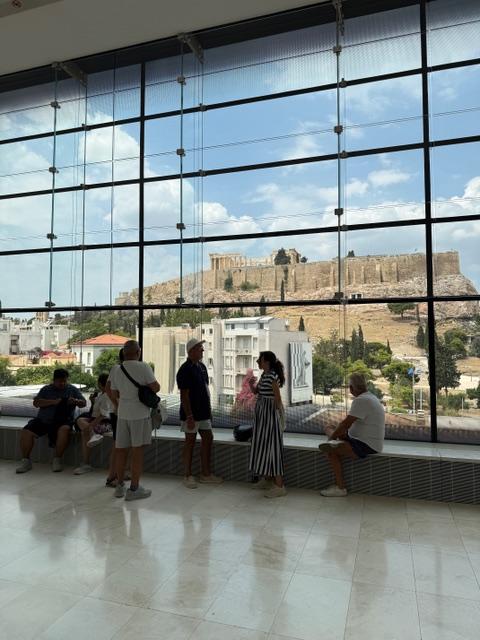
The Gods were never straight
Start with the myths, because the Greeks did. Zeus, king of the Gods, falls so hard for the beautiful young prince Ganymede that he carries him up to Olympus to live among the immortals. A same-sex romance so famous it echoed through art for centuries. Apollo loved the Spartan youth Hyacinthus and mourned him with a flower when he died. Poseidon, Heracles, Dionysus — nearly every major figure in the pantheon has a male lover somewhere in the tradition.
Then there is Achilles and Patroclus, whose bond anchors the Iliad itself. Ancient readers had no doubt it was a love story; it took much later hands to recast them as “just good friends.” And the poet Sappho, writing from the island of Lesbos, gave us verses of desire between women so enduring that her home and her name became our words: lesbian, sapphic.
History, not just legend
This wasn’t only mythology. It was social reality. Perhaps the most striking example is the Sacred Band of Thebes who were an elite fighting force of 150 male couples, 300 men in all, formed on the belief that no soldier would fight harder than one battling beside the man he loved. They were considered nearly invincible until they fell together at the Battle of Chaeronea in 338 BCE, where a stone lion was raised over their shared grave. It still stands today.
In Athens, the lovers Harmodius and Aristogeiton were remembered as heroes of the city’s democracy, honored with public statues. Across the Greek world, relationships between men were woven openly into education, politics, art, and religion. The gender fluidity we sometimes treat as a contemporary conversation was, 2,500 years ago, carved into temple friezes and painted onto everyday pottery.
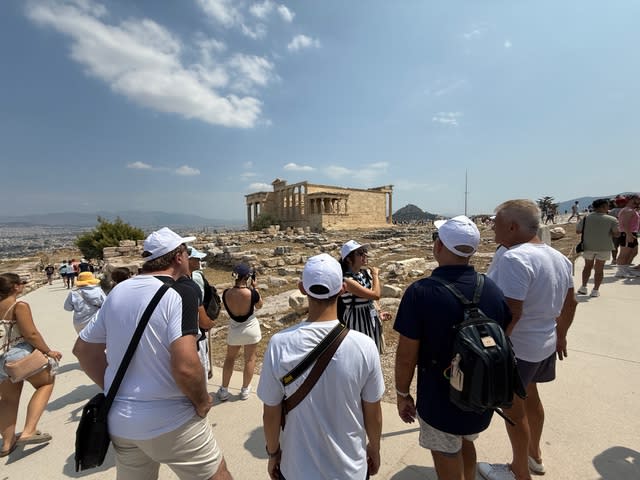
How the story got buried
So where did it go? The erasure was gradual, and much of it was deliberate. As Christianity rose across the Mediterranean, the frank sexuality of the old world was recast as sin. Texts were recopied selectively, statues reinterpreted, festivals rebranded. Later, Victorian translators finished the job, softening “lover” into “friend,” leaving the more explicit passages untranslated in the original Greek so only the “right” readers could reach them, and quietly straightening the gods.
The result is a history most of us were handed with the queerness scrubbed off. The marble stayed; the meaning was rewritten. Recovering it isn’t revisionism, it’s simply reading what the Greeks actually wrote, and looking at what they actually built.
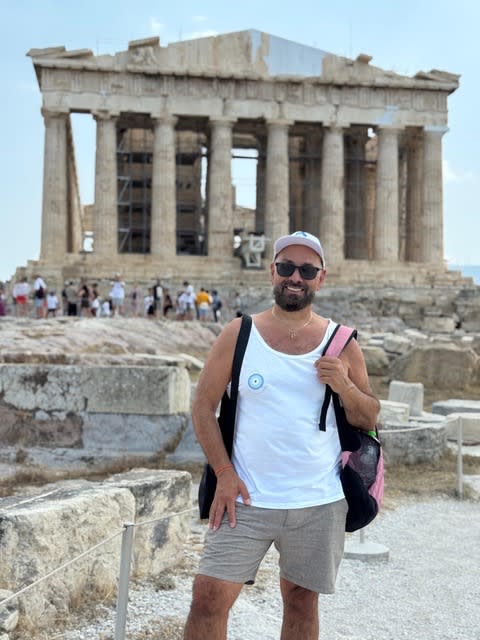
Seeing it in person
This is the part that stays with travelers. Standing in the Acropolis Museum, you realize that objects you’d have walked straight past, a vase, a fragment of sculpture, an inscription, are telling a far more complex story about desire and gender than any classroom let on. Walk up to the Parthenon, look toward the colossal Temple of Olympian Zeus, wander the alleys of Plaka, and the ancient city stops being a ruin and becomes a place where queer life was once lived out loud.
It’s why we built our Athens Ancient Sites & Gay History walking tour around exactly these places, led by a licensed archaeologist who specializes in LGBTQ+ history. But you don’t need a guide to make the point. Bring the questions with you, look closely, and let the stones answer.
Athens was queer long before the modern word for it existed. That isn’t a reinterpretation of the past. It’s the past, finally allowed to speak for itself.
About the Author
Monobrow Gay Tours Greece designs private, LGBTQ+-focused experiences across Greece. Find us on the IGLTA member directory: https://www.iglta.org/listing/monobrow-gay-tours-greece/